


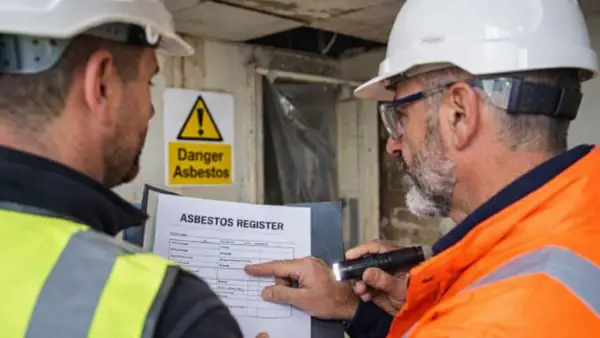
Asbestos Awareness Week 2026 is an important reminder that asbestos is not just a historic health and safety issue. It is still the biggest cause of work-related deaths in Great Britain, remains present in many buildings built or refurbished before 2000, and continues to put construction, maintenance, refurbishment and facilities teams at risk when it is disturbed.
Global Asbestos Awareness Week runs from 1 to 7 April 2026, and this year’s timing matters. HSE is using the week to highlight that inspectors are actively checking how asbestos is managed in buildings and on sites, while reminding dutyholders and tradespeople that knowing where asbestos is, understanding who is responsible, and preventing disturbance remain essential parts of legal compliance and worker protection.
In this guide
- Why asbestos is still such an important issue
- Why the danger has not gone away
- The human impact behind the statistics
- What employers and dutyholders should be doing now
- Why asbestos awareness training still matters
- Conclusion
Why asbestos is still such an important issue
The most powerful reason asbestos still matters is simple: it is still killing people. HSE says asbestos causes around 5,000 deaths each year in Great Britain, and describes it as the greatest cause of work-related deaths. The latest HSE figures also show 2,218 mesothelioma deaths in 2023, a disease strongly linked to past asbestos exposure.
That alone makes Asbestos Awareness Week more than a diary event. It is a public reminder that exposure from decades ago is still resulting in deaths now because asbestos-related diseases have long latency periods. GOV.UK’s official mortality release explains that mesothelioma and asbestosis deaths today reflect the legacy of earlier exposure, especially from the years when asbestos was widely used across British industry and construction.
This is also why asbestos cannot be treated as an issue only for specialist removal contractors. HSE makes clear that asbestos can still be present in any building built or refurbished before 2000, which means the risk extends to maintenance staff, electricians, plumbers, joiners, surveyors, decorators, demolition workers, facilities teams, landlords, building managers and contractors carrying out small routine jobs.
Why the danger has not gone away
Many people hear that asbestos was banned and assume the problem disappeared. In reality, the ban stopped new use; it did not remove the asbestos already installed in thousands of workplaces, schools, hospitals, industrial premises and domestic properties. HSE guidance still warns that asbestos may be found in common materials such as ceiling tiles, insulation, pipe lagging, boilers, sprayed coatings and other building products in older premises.
The real danger comes when asbestos-containing materials are damaged or disturbed. Cutting, drilling, sanding, breaking, stripping out or even carrying out seemingly minor maintenance can release fibres into the air. Those fibres are invisible, can be inhaled without immediate symptoms, and may lead to diseases many years later. HSE and WHO both continue to stress that asbestos exposure remains a serious health risk, while IARC states that all forms of asbestos are known to cause cancer in humans.
That is why asbestos is still so relevant to today’s construction and building management sectors. The issue is not only major refurbishment or licensed removal work. It is often the small, routine, everyday tasks in older buildings that create the biggest danger when workers do not know asbestos is present. HSE’s current campaign messaging reflects exactly that point: know your building, know your duty, and act on both.
The human impact behind the statistics
Statistics matter, but they can make asbestos feel remote. In reality, every asbestos death represents a person who went to work, or entered a building, without realising that exposure could affect them decades later. GOV.UK’s mortality data and HSE’s summaries show the scale of the national burden, but the true impact is measured in families changed by preventable disease, lost careers, avoidable suffering and years of uncertainty before diagnosis.
The BBC article you highlighted is useful because it helps bring that impact into focus for a wider public audience. Even without repeating unverified details here, it serves as a reminder that asbestos harm is not abstract, and not confined to old industrial stories from the past. When asbestos is mishandled, overlooked or poorly managed, the consequences can reach workers, occupants, pupils, patients, families and communities long after the original exposure took place. That broader risk profile is consistent with HSE guidance on older buildings and with current concern around asbestos in public buildings such as schools and hospitals.
That same lesson is visible in recent enforcement. In June 2025, HSE reported that a site supervisor was fined after school pupils and staff were exposed to asbestos during refurbishment work in Bristol. It is a stark example of why asbestos awareness, competent planning and proper controls still matter now, not just in theory but in live working environments where vulnerable people may be nearby.
What employers and dutyholders should be doing now
Asbestos Awareness Week is a good time for organisations to ask some direct questions. Do we know which buildings on our site may contain asbestos? Is the asbestos register up to date? Have we identified who holds the duty to manage? Are contractors given the right information before they start work? Are surveys, plans and permits actually being checked on the ground, or just filed away? HSE says dutyholders should identify asbestos, assess the risk, keep an asbestos management plan and provide information to anyone liable to disturb it.
For many organisations, the most important practical steps include:
- checking whether premises were built or refurbished before 2000
- reviewing the asbestos register and survey information
- making sure planned work is assessed before it starts
- stopping work immediately if suspect materials are uncovered
- ensuring only properly trained and, where required, licensed people carry out asbestos work
- communicating asbestos information clearly to contractors and maintenance teams.
This matters because asbestos awareness alone is not the same as permission to work on asbestos. HSE is clear that asbestos awareness training is intended to help workers avoid disturbing asbestos. It does not qualify them to carry out licensable work, and it is not a substitute for the specific information, instruction, risk assessment and controls required for actual asbestos work.
Why asbestos awareness training still matters
Good asbestos awareness training remains important because it helps workers recognise when they may be entering a higher-risk situation. That includes understanding where asbestos may be found, what to do if suspect materials are discovered, why drilling or disturbing materials can be dangerous, and when work must stop. HSE’s worker guidance says that if you unexpectedly come across potential asbestos, you should stop work immediately, assume it may be asbestos unless proven otherwise, and carry out the right risk assessment process.
For Goldcross readers, this creates a clear training pathway. Teams likely to encounter asbestos during routine work can strengthen awareness through Asbestos Awareness training, while organisations wanting broader day-to-day safety competence can also review Health & Safety Awareness courses and the wider range of E-Learning Courses available through Goldcross. Goldcross’s own course information states that its asbestos awareness training is designed for workers such as builders, plumbers, electricians, carpenters and other maintenance or building-related trades who may come into contact with asbestos in their work.
That is exactly why the message of this year’s awareness week remains so relevant. The risk often sits at the point where routine work meets an older building. If a worker knows when to stop, check the register, question the material and escalate concerns, exposure can be prevented. If they do not, one quick task can create lifelong consequences.
Conclusion
Asbestos Awareness Week 2026 matters because asbestos is still present, still misunderstood and still deadly. The UK has banned its use, but it has not escaped its legacy. Around 5,000 deaths a year, thousands of mesothelioma cases over time, and ongoing HSE enforcement all point to the same conclusion: asbestos awareness is still a core health and safety issue for anyone responsible for older buildings or anyone likely to disturb the fabric of those buildings during work.
The strongest message for employers, dutyholders and workers is not complicated. Do not assume asbestos is someone else’s problem. Check the building age, check the records, check the plan, and make sure people have the right information before work begins. Awareness is not about creating alarm; it is about preventing avoidable exposure and making sure today’s work does not become tomorrow’s diagnosis.
If your team works in construction, refurbishment, maintenance, surveying or facilities management, this is the right time to refresh asbestos awareness and review whether your current controls are strong enough. Explore Goldcross’s Asbestos Awareness training and wider health and safety courses to help workers recognise risk early and avoid disturbing asbestos in the first place.
FAQ
Why is asbestos still important in the UK?
Because asbestos is still present in many older buildings and continues to cause around 5,000 deaths each year in Great Britain.
Can asbestos still be found in buildings today?
Yes. HSE says asbestos can still be present in buildings built or refurbished before 2000.
Does asbestos awareness training allow someone to work on asbestos?
No. HSE says asbestos awareness training is intended to help workers avoid disturbing asbestos, not to qualify them to carry out asbestos work.
What should a worker do if they unexpectedly find possible asbestos?
Stop work immediately, assume it may be asbestos unless confirmed otherwise, and follow the correct risk assessment and control process.